Hollywood's Best Press Tour Is Happening in Your Earbuds
The press junket used to be a ritual of controlled exposure. You put a movie star in a hotel suite, handed them a bottle of water, and asked the same six questions until the quotes were smooth enough to print. Everyone knew the game. The studio got its feature stories. The talent got to promote the movie without accidentally saying anything interesting. The reporter got a usable paragraph and a free cookie.
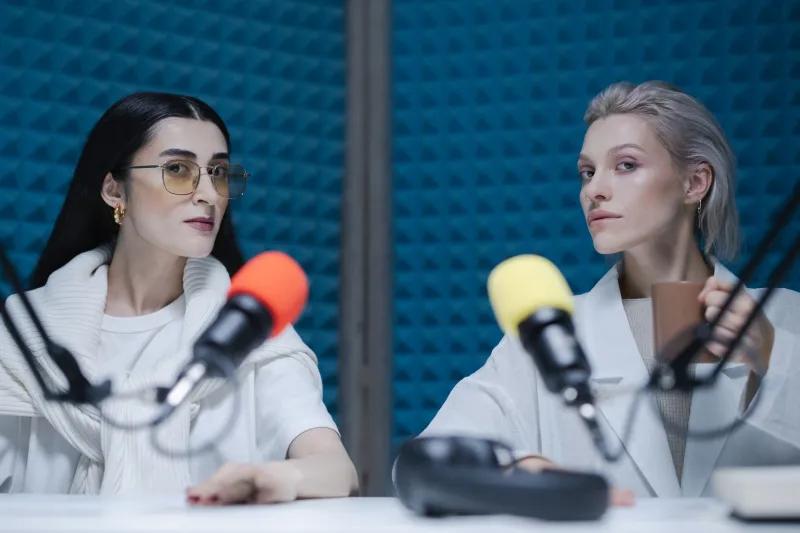
That game is not dead, exactly. It is just no longer where the good stuff happens. The best interviews in Hollywood now run ninety minutes, arrive with ads for mattress companies, and live in your podcast app. Actors and directors are saving their sharpest anecdotes, their weirdest contradictions, and their most candid industry talk for long-form audio. The junket gave us product demonstrations. The podcast gives us people.
The Junket Was a Product Demo
A junket is designed to produce clips. That is not a cynical reading; it is the business model. The room is small, the schedule is tight, and the publicist is usually within eye contact. Questions are pre-approved in spirit if not in writing. The talent has been trained to answer the plot question, the co-star question, and the what-was-it-like-on-set question. Anything more interesting gets a polite pivot and a return to the release date.
This is why junket interviews so often sound like they were conducted by a machine. They are not conversations. They are transactions with a microphone in the room. The star is not there to think out loud. They are there to remind you that the movie opens Friday.
The Podcast Is a Conversation
A podcast has different physics. It is long. It is unedited in the way that matters. It has dead air, tangents, and the possibility of a guest saying something they did not plan to say. That possibility is the entire appeal. When a director explains why a studio note ruined a third act, or an actor admits they almost quit the business, or a comedian tells a story that makes the publicist in the room audibly shift in their chair, the listener gets something the junket cannot provide: context.
Long-form audio also lets contradictions breathe. A star can say they love the craft and hate the marketing. They can be grateful for the franchise and resent what it cost them. They can praise a director and then describe a set that sounds like a hostage negotiation. In a junket, those contradictions get flattened into a headline. On a podcast, they get to be what they are: the messy interior life of a person who happens to be famous.
The Contradiction Is the Point
Critics should care about this because promotion is not separate from the work. It is part of the public record. The way a filmmaker talks about their own movie tells you what they think they made. The way an actor describes a collaborator tells you what the set was like. The way a star handles a hostile question, or a weird tangent, or a moment of silence, tells you something about the performance of celebrity itself.
Podcasts have become one of the most revealing spaces in entertainment criticism because they let the performance of promotion become visible. You can hear the gears turning. You can hear the moment a guest decides to be honest. You can hear the difference between a rehearsed anecdote and a story that just occurred to them. That is not gossip. That is evidence.
What Long-Form Audio Exposes
The junket model assumes that audiences want polish. Podcasts assume they want proximity. That shift has exposed how much of Hollywood's official storytelling is built on avoidance. Stars are trained to talk around the movie rather than about it. Directors are trained to praise the studio. Publicists are trained to keep the conversation on the release date. Long-form audio makes that training sound exactly like what it is: a script.
It also exposes the limits of the old criticism. If we only review the movie and ignore the interview, we miss the way the movie is being framed. If we only quote the junket, we miss the way the star actually thinks. The podcast has become the press tour's backstage pass, and critics who ignore it are reviewing the performance without watching the rehearsals.
The Publicist's New Nightmare
None of this means podcasts are pure. They are still promotional. They are still booked by publicists. They still have sponsors and incentives and hosts who want access. But the length changes the math. A ninety-minute conversation cannot be entirely sanitized. Something will slip. A grudge, a regret, a strange opinion about a director, a confession about a franchise. That is why the best podcast interviews feel like found footage.
The junket died because it could not compete with that. It gave audiences a polished version of a person who had already been polished by a studio. The podcast gives them the rough cut. And in 2026, the rough cut is where the story is.